When to Book a Wedding Photographer: How Far Ahead You Actually Need To
We photograph and film weddings out of New York and Los Angeles, and we travel through the rest of California for them, so we watch this play out from the inside every season. Our Saturdays in September and October are gone first, usually a year to eighteen months out, and the couples who call us in March for a fall date that year are almost always calling too late. The honest version of this answer is not one number. It depends on your date, your day of the week, your market, and how attached you are to one specific photographer. Below is the timeline broken down by each of those, with what actually happens if you miss the window.
Quick Answer:
Book your wedding photographer 12 to 18 months before your wedding date. Peak-season Saturdays from May through October need the full 14 to 18 months, and in-demand studios in New York and Los Angeles fill those dates 18 to 24 months out. Fridays, Sundays, and off-season dates are safe at 8 to 12 months. Weekday weddings and elopements can be booked 2 to 6 months ahead. The trigger is not the calendar, it is your signed venue contract: once your date and venue are locked, start contacting photographers that week.
In this article
- How far in advance should you book a wedding photographer?
- What has to be settled before you can book?
- How does your date and season change the timeline?
- Does the timeline change in New York, Los Angeles, and across California?
- How much does a wedding photographer cost, and does booking early save money?
- What actually happens if you book late?
- Month-by-month booking timeline
- How we handle photo and film as one booking
- Frequently asked questions
How far in advance should you book a wedding photographer?
Book 12 to 18 months out. That is the standard lead time The Knot gives for photographers and videographers, alongside venue, planner, and caterer, and it matches what we see on our own calendar. For peak-season Saturdays, push to the top of that range. For weekdays, off-season dates, and elopements, you have considerably more room than the industry's blanket advice suggests.
The reason photographers get named in that first booking tier, with the venue and the caterer, is arithmetic rather than urgency marketing. A photographer covers one wedding per day. A florist can service three weddings on the same Saturday, a bakery can service ten, but your photographer either has your date or does not. There is no version where a studio doubles capacity for a popular weekend. With 88 percent of couples hiring a photographer and the average couple engaged for about 15 months, demand for a small number of Saturdays concentrates fast.
A useful way to frame it: the average engagement is 15 months, and photographers should be booked 12 to 18 months ahead. Those two numbers overlap almost completely. In practice that means the photographer search belongs in the first quarter of your engagement, not the middle of it.
What has to be settled before you can book?
Three things: a signed venue contract with a confirmed date, a rough photography budget, and a decision on whether you want video. Without a date, no photographer can check availability, so calls go nowhere. Without a budget range, you will spend weeks on studios you were never going to book. Without a video decision, you may hire twice and pay more.
The venue drives everything. Your date is not real until the venue contract is signed, because venues hold a limited number of Saturdays and will not reserve one on a verbal hold indefinitely. Popular venues in both our markets book 12 to 24 months out, and some estates and landmark spaces go further. Chase the venue first, then the photographer, in that order and usually within the same month.
On budget, you do not need a precise figure, you need a floor and a ceiling. Photography typically runs about 9 percent of a total wedding budget, which on the current national average of $34,000 puts the honest planning number around $3,000 to $4,500 before you factor in market. Knowing that going in changes which inquiries you send.
On video, decide early even if you decide against it. Adding video after you have booked a photographer means introducing a second team that has never worked with the first, negotiating who stands where during the ceremony, and paying two separate travel and coverage minimums. Deciding up front lets you consider a single photo and film team, which is usually cheaper and always cleaner on the day.
How does your date and season change the timeline?
Your date type matters more than any other single factor. Over 67 percent of couples marry in summer or fall, and every one of The Knot's top five dates for 2026 landed on a Saturday: June 6, June 20, September 19, September 26, and October 10. Those specific Saturdays are effectively a national bidding war for a fixed number of photographers. A Thursday in February is not.
Peak Saturdays, roughly May through October, need 14 to 18 months, and studios with press features or a waitlist commonly close those dates 18 to 24 months ahead. If you want a specific photographer on a specific peak Saturday, you are competing with every other couple who found the same portfolio.
Off-season Saturdays, November through April excluding the holidays, sit around 10 to 14 months. There is still competition, because Saturday is Saturday, but the pool of couples is smaller and most studios have open dates deeper into the calendar.
Fridays and Sundays have quietly become a real strategy. At 8 to 12 months you can still reach photographers who closed their Saturdays a year ago, and many studios price Friday and Sunday below Saturday. Couples who care more about who shoots their wedding than which day of the week it falls on get noticeably better access here.
Weekdays and elopements run 2 to 6 months, sometimes less. We have filmed intimate weddings booked six weeks out. The constraint moves from photographer availability to your own planning time.
Destination weddings flip back the other way and need 18 months or more, because you are coordinating travel, lodging, permits, and often a scouting day on top of the date itself.
Does the timeline change in New York, Los Angeles, and across California?
Yes, in both directions. In New York and Los Angeles you are pulling from a deep bench of photographers, so there is almost always someone available, but the specific studios couples actually want are booked earlier than the national timeline suggests. Assume 18 months for a peak Saturday and treat 12 months as late rather than early. Elsewhere in California the constraint shifts from competition to logistics and local calendars.
New York compresses hardest. The city's wedding season stacks into a narrow window, roughly May through June and then September through October, and the venues that anchor those weekends, the Brooklyn waterfront spaces, the Hudson Valley estates, the landmark hotels, release dates on their own long schedules. When a venue confirms a September Saturday eighteen months out, the photographer inquiries go out that same week. Add that New York weddings are frequently multi-day or multi-event, with a welcome party, a rehearsal dinner, and sometimes a separate cultural ceremony, and you are booking a block of a photographer's calendar rather than a single day.
Los Angeles behaves differently. The season is longer, October and November stay genuinely usable, and the light holds late into the year, which spreads demand across more of the calendar. That buys you a few months of slack on off-peak dates. It does not help on peak dates, because LA competes for photographers with editorial, commercial, and event work, so the calendars of the studios doing the most interesting wedding work fill from more than one direction. Malibu is part of this, not separate from it: it sits inside the LA market and books on the same peak-Saturday clock as the rest of the county, with a permit layer on top.
What changes if your wedding is elsewhere in California?
The state does not run on one calendar, and that is the part couples planning outside Los Angeles get wrong. Book 12 to 18 months out as a baseline, then adjust to the local season and the local rules, because in most of California the binding constraint is not photographer supply, it is the venue's own booking window.
Santa Barbara is the clearest example. Courthouse ceremonies open reservations only 90 days ahead, and the popular slots go quickly inside that window. A small ceremony there also caps at fifteen people at the Hall of Records, and your photographer counts toward that fifteen, which is the detail that catches couples out on the day. Your photographer can be booked a year in advance; the ceremony slot cannot be booked until three months out, so the two timelines run separately.
Napa and Sonoma invert around harvest. From roughly August through October the wineries are running crush, which is when availability tightens, prices rise, and some estates stop hosting altogether. That pushes wine country weddings into late spring and early autumn shoulders, and it means the venue, not the photographer, dictates how early you have to commit.
The desert flips the national season completely. In Greater Palm Springs and Joshua Tree the popular wedding months are March through May and October through November, because summer temperatures run well into the 100s. Winter days sit in the 70s and nights drop to the mid-40s. So a desert Saturday in November is a peak date competing for peak-date photographers, while a desert Saturday in July is nearly uncontested and mostly a bad idea. Plan the light around it too: ceremonies wait out midday heat and the portraits land late in the afternoon.
San Diego runs on its own permit calendar rather than on photographer supply. The city publishes a fixed list of park and shoreline sites where wedding permits are issued at all, each with a hard headcount: Cuvier Park, the Wedding Bowl, caps at 50, Ellen Browning Scripps Park drops from 80 guests to 50 between June and August, and Coronado issues no Central Beach permits on weekends from May through September. Sites open for reservation a year ahead on the first working Monday of the month. So your photographer is the easy part, and the ceremony site is the thing to chase first.
Big Sur and the state parks add their own layer, since anything on state park or protected land needs a special event permit filed well in advance, and permit lead time rather than photographer availability becomes the thing that sets your date.
For any of these we block travel days around the wedding rather than a single date, which is why booking earlier matters more outside the city than in it. All of these markets share one thing: the photographers who have actually worked your venue are worth reaching first. Venue familiarity determines whether someone knows where the sun sits at 5 pm in your ceremony space, which rooms
| Wedding date type | Book photographer | Top studios close | Best for |
|---|---|---|---|
| Peak Saturday (May–Oct) | 14–18 months out | 18–24 months out | Couples set on one specific photographer or venue |
| Off-season Saturday (Nov–Apr) | 10–14 months out | 12–15 months out | Couples who want a Saturday but not a peak-season price |
| Friday or Sunday, any season | 8–12 months out | 10–14 months out | Couples who care more about who shoots it than which day it is |
| Weekday wedding | 4–8 months out | Rarely closed early | Smaller guest counts and city-hall plus dinner formats |
| Elopement or micro-wedding | 2–6 months out | Rarely closed early | 20 guests or fewer, flexible on date and location |
| Destination wedding | 18+ months out | 18–24 months out | Couples marrying abroad or out of state, with travel and permits |
How much does a wedding photographer cost, and does booking early save money?
The national average sits between $3,000 and $4,400 depending on which study you use, with most couples spending roughly $3,500 to $5,300. New York averages about $5,000, and the Mid-Atlantic and Northeast run $3,700 to $3,800 against a national median of $2,800. Booking early does not usually get you a discount, but it does lock the current year's rate before an annual increase.
The two national figures are worth explaining, because couples get whiplash comparing them. The Knot's Real Weddings Study, based on 10,474 couples married in 2025, reports an average of $3,000, with a lower quartile of $1,500, a median of $2,800, and an upper quartile of $4,700. Zola's Wedding Cost Index reports $4,400 nationally, with most couples between $3,500 and $5,300. Both are accurate for what they measure. The Knot surveys all couples, including small weekday weddings and short coverage; Zola indexes vendor pricing, which skews toward full-day professional packages. If you are planning a full Saturday wedding with eight or more hours of coverage, the Zola range is the more realistic planning number.
What actually moves the price is hours, shooters, and deliverables. Basic packages cover six to eight hours with one photographer, standard packages run eight to ten hours, and premium packages start at ten hours and typically add a second shooter, an album, and faster delivery. Guest count matters too, mostly through time: The Knot's data shows $2,000 at 1 to 50 guests, $2,700 at 51 to 100, and $3,500 at 101 and above, which reflects how much longer group portraits and coverage take at scale.
On the early booking question specifically, be skeptical of anyone who tells you prices rise if you wait. Many photographers do raise rates annually, so a contract signed in 2026 for a 2027 wedding typically holds 2026 pricing, and that is a real if modest saving. The larger cost of waiting is not the rate, it is the substitution. You do not pay more for the photographer you wanted, you pay a similar price for a different photographer whose work you liked less.
What actually happens if you book late?
Your date does not go uncovered. Something is always available. What disappears is choice, and specifically the top of your list. Couples who start searching six months out for a peak Saturday routinely find that every photographer they saved is booked, and they end up choosing from what remains rather than from what they wanted.
The second thing that goes is leverage on the details. Late bookings mean less negotiating room on hours, second shooters, engagement sessions, and payment schedules, because the photographer knows you have limited alternatives. Some studios also charge a rush or short-notice premium.
The third thing, and the one couples underestimate, is the relationship. Booking a year out means you have time for an engagement session, a venue walkthrough, and a timeline conversation with your photographer before the wedding. Booking eight weeks out means the first time you meet them properly is the morning of, which shows in the getting-ready photos more than people expect.
Late booking is recoverable. If you are inside six months on a peak date, widen your search immediately to Friday and Sunday specialists, ask your venue and planner who they have seen do good work, and ask photographers directly if they have an associate team. Do not wait another month hoping something opens.
Month-by-month booking timeline
Your date does not go uncovered. Something is always available. What disappears is choice, and specifically the top of your list. Couples who start searching six months out for a peak Saturday routinely find that every photographer they saved is booked, and they end up choosing from what remains rather than from what they wanted.
The second thing that goes is leverage on the details. Late bookings mean less negotiating room on hours, second shooters, engagement sessions, and payment schedules, because the photographer knows you have limited alternatives. Some studios also charge a rush or short-notice premium.
The third thing, and the one couples underestimate, is the relationship. Booking a year out means you have time for an engagement session, a venue walkthrough, and a timeline conversation with your photographer before the wedding. Booking eight weeks out means the first time you meet them properly is the morning of, which shows in the getting-ready photos more than people expect.
Late booking is recoverable. If you are inside six months on a peak date, widen your search immediately to Friday and Sunday specialists, ask your venue and planner who they have seen do good work, and ask photographers directly if they have an associate team. Do not wait another month hoping something opens.
Month-by-month booking timeline
Here is how the whole sequence runs, assuming a peak-season Saturday and an average 15-month engagement. Compress it proportionally for off-season and weekday dates.
At 18 to 15 months, lock the venue and date, set the photography budget, and decide on video. Start collecting references: full galleries rather than Instagram grids, and at least three studios whose work holds up across a whole wedding.
At 15 to 12 months, contact photographers, check availability for your exact date, and take calls. Ask for a full wedding gallery start to finish, not a curated selection, and ask specifically about your venue. Sign and pay the deposit in this window. This is the booking, and for peak Saturdays it should not slip.
At 12 to 9 months, book the remaining vendors your photographer's timeline depends on: hair and makeup, florist, band or DJ. Schedule your engagement session if it is included.
At 9 to 6 months, shoot the engagement session and use it to get comfortable on camera and to test how you work together. Start drafting the wedding day timeline with your photographer's input, especially around sunset, since golden hour is a fixed constraint that everything else bends around.
At 6 to 3 months, finalize the timeline, confirm any second shooter, and walk your photographer through the venue if they have not worked it. Confirm the shot list of family groupings, which is the one list that genuinely saves time on the day.
At 3 to 1 months, confirm arrival times, addresses, meal arrangements, and the final payment schedule. Send your photographer the planner's master timeline.
In the final month, confirm nothing changed and stop planning. Everything that matters is already in writing.
How we handle photo and film as one booking
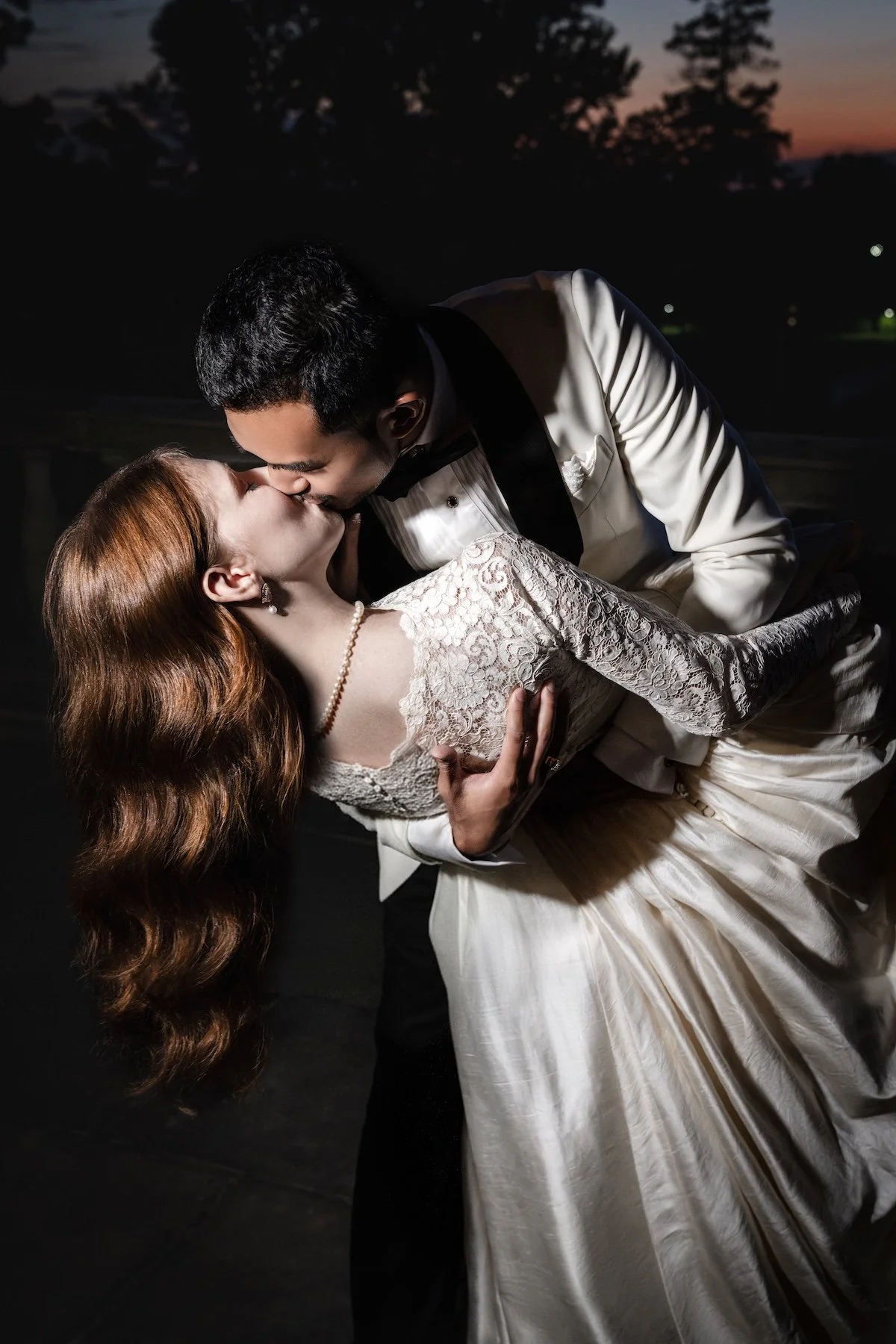
We shoot photo and film as one team off a single timeline, which is why our booking conversation covers both at once rather than as two separate hires. In practice that means one contract, one set of coverage hours, and two crews that already know where the other will be standing during your vows.
The reason this matters on the day is positioning. When a photographer and a videographer are hired separately and meet for the first time at your ceremony, they compete for the same three good angles. One of them ends up in the other's frame, or both compromise and shoot from the sides. Working as one team, we plan those positions in advance: who takes the aisle, who takes the reverse angle, who moves during the ring exchange. Both galleries end up covering the same moments from complementary angles instead of the same angle twice.
The rest of our setup is built for the parts of a wedding day that go wrong. We record ceremony audio from multiple sources, a lav on the officiant or groom plus a recorder on the house system, so your vows come back clean in a stone church or against wind on a bluff. We shoot with backup camera bodies and write every key moment to two cards at once, because a wedding has no second take. We carry lighting for dark ballrooms and late receptions, and run a gimbal and handheld hybrid so movement stays smooth in tight rooms.
If you are early in your planning and want to see how a full day looks in both photo and film before you commit, we will walk you through complete galleries rather than a highlight reel.
Ready to check your date?
If you have your venue and date confirmed, the next move is finding out who is still available, and that answer changes weekly during peak season. Send us your date and venue and we will tell you straight away whether we are open, what full-day photo and film coverage looks like for your timeline, and what we would plan for the light at your specific location.
Frequently asked questions
-
Book 12 to 18 months ahead. Peak-season Saturdays from May through October need the full 14 to 18 months, and sought-after studios in New York and Los Angeles close those dates 18 to 24 months out. Fridays, Sundays, and off-season dates are workable at 8 to 12 months, and weekday weddings or elopements at 2 to 6 months. Start the search the week your venue contract is signed.
-
For a peak-season Saturday, yes, in the sense that your first choices will be gone. Your date will still get covered, but you will be choosing from remaining availability rather than from the photographers whose work you liked most. For a weekday, off-season, or Friday or Sunday wedding, six months is comfortable. If you are inside six months on a peak date, contact photographers directly and ask about associate shooters.
-
The venue, always. Your date is not confirmed until the venue contract is signed, and photographers cannot check availability without a date. Book the venue, then contact photographers within the same week, since both sit in the same 12 to 18 month tier and photographers can only cover one wedding per day. Waiting for other vendors to fall into place first costs you the photographer.
-
Roughly $3,000 to $4,400 nationally depending on the study, with most couples spending $3,500 to $5,300, or about 9 percent of the wedding budget. New York City averages around $5,000 and the Northeast and Mid-Atlantic run $3,700 to $3,800. Basic packages cover six to eight hours with one photographer, standard eight to ten hours, and premium ten or more with a second shooter.
-
Many raise rates annually, so booking now typically locks the current year's pricing for a following-year wedding. That is a real but modest saving. The larger cost of waiting is not price, it is availability. Late bookers usually pay a similar amount to a different photographer, having lost access to their first choices, and have less negotiating room on hours, second shooters, and payment terms.
-
Book 18 months or more ahead. Destination weddings add travel, lodging, permits, and often a scouting day, and photographers block more than a single date for them. You also want a photographer with real experience shooting away from home, since the logistics of gear travel, backup equipment abroad, and unfamiliar light are where inexperienced vendors run into trouble.
-
Start at 12 to 18 months, then adjust to the local calendar. Santa Barbara courthouse ceremonies only open reservations 90 days out, so the photographer is booked long before the slot exists. Napa and Sonoma tighten during harvest from August through October. Palm Springs and Joshua Tree peak from March to May and October to November, since summer runs past 100 degrees.
-
Decide on video before you book either. Adding a videographer after the photographer is signed means two teams meeting for the first time at your ceremony and competing for the same angles. Booking one team for photo and film, or booking both at the same time so they can coordinate, gives you galleries that cover the same moments from complementary positions rather than duplicating each other.
-
Most photographers deliver in four to twelve weeks, with a sneak peek of a few images within the first week or two. Confirm the turnaround in the contract before you book, since peak-season deliveries run longer when a studio is shooting every weekend. Ask specifically what happens if delivery slips, and get the answer in writing rather than as a verbal assurance.