

How to Plan a Winter Wedding
We photograph and film weddings in New York and Los Angeles, and winter is the season where the plan carries the day. In June you can be an hour behind schedule and still get your portraits. On a Saturday in December in New York the sun is gone at 4:31 pm, and an hour behind schedule means the portraits happen in a parking garage with a light stand. Everything below is the arithmetic we run before a winter date, written out.
Quick Answer:
Planning a winter wedding comes down to four decisions the warm months let you make loosely. Choose a date away from the holiday weekends and send save the dates eight months out. Build the whole day backward from a 4:30 pm sunset, because in December your portrait window closes before most summer receptions even start. Separate the parts of the budget that genuinely drop in the off season from the parts that never move. And treat snow as a bonus, since Central Park averages about two snowy days in all of December.
In this article
- Is winter a good time to get married?
- What are the unique challenges of a winter wedding?
- How do you build a timeline around a 4:30 pm sunset?
- Will it actually snow on your wedding day?
- How much does a winter wedding cost?
- How do you keep guests warm?
- What changes about photography and film in winter?
- Frequently asked questions
Is winter a good time to get married?
Winter is a good time to get married if you want your first choice of date, venue and vendors, and a poor one if your plan depends on being outdoors for any length of time. Roughly a quarter of American weddings happen in the colder half of the year, so the calendar you are competing for is close to empty compared with October.
The Knot puts peak season at May through October and says 76 % of weddings take place in that window, which leaves 24 % for November through April. Their pricing data, drawn from the 2025 Real Weddings Study of 10,474 couples, gives 23 % for November through March, with 9 % in November, 5 % in December and 2 % in January.
Those two pages of the same publication put December at 1 % and at 5 %. The gap is worth understanding before you quote either number at your parents. The windows are different, six months against five. The studies are different years with different samples. And a share this small rounds hard: on a base of ten thousand couples, a few hundred weddings move December a full percentage point. What survives both readings is the shape. About a quarter of weddings happen between late autumn and early spring, and December and January sit at the bottom of the list.
That scarcity is the whole argument for a winter date. The venue you were told had nothing until 2028 has open Saturdays in January. The band, the planner and the photographer you actually wanted are free. Your guests are not attending their third wedding of the month, so the people who matter to you turn up. For a couple who got engaged over the holidays and does not want to wait eighteen months, winter is often the only way to marry inside a year without settling for the leftovers of the calendar.
The costs are real too, and they are not mainly financial. You lose daylight, which reshapes the entire day and is covered in detail below. You take on weather variance that can slow guests and vendors. And you compete with the holiday calendar for people's time and money, which is why the date you pick inside winter matters more than the decision to marry in winter at all.
What are the unique challenges of a winter wedding?
There are five, and only one of them is the cold. Short daylight compresses your photography window into the middle of the afternoon. Weather variance threatens travel more than it threatens the ceremony. Guests have coats, which is a logistics problem at scale. Holiday weekends compete for attendance. And several vendor categories quietly cost more in winter, not less.
Daylight is the challenge that changes your schedule. Daylight is the frame the whole timeline gets built inside, and it is settled months before the day. A ceremony at 4 pm in December in New York is an evening ceremony, lit by whatever the room has.
Weather variance mostly shows up as travel. Across the winter weddings we have shot, the days the roads were bad cost more than the days it snowed. Snow at the venue is a gift. Snow on the interstate three hours earlier is a florist who arrives at four and a grandmother who misses the ceremony.
Coats are a real operational problem. A hundred and fifty guests arriving in coats is a hundred and fifty coats, and if the venue staffs coat check with two attendants you have built a twenty minute line into the start of your cocktail hour.
The holiday calendar competes for attendance. Thanksgiving weekend, the week of Christmas and New Year's Eve all carry a price, either in guest travel costs or in venue premiums.
Some categories go up. Heating rentals are a line that summer weddings never have. Peonies and dahlias are out of season and arrive by air. Neither of these appears in the articles that promise a cheaper winter wedding.
How do you build a winter wedding timeline around a 4:30 pm sunset?
You build it backward from sunset, and you do it before you sign the venue contract, because the ceremony start time you agree to determines whether you get portraits at all. In New York in December the sun sets at 4:30 pm, so the last usable light is between roughly 3:00 and 4:30 pm. Anything that has to happen outdoors is scheduled inside that ninety minutes.
The exact times are published and worth checking for your own date. In New York, sunset on December 1, 2026 is 4:30:55 pm, the earliest sunsets of the year sit around 4:30 pm through the first three weeks of the month, and by December 31 it has crept back to 4:39:55 pm. Civil twilight, the point at which handheld photography without added light stops working, ends about half an hour after sunset. In Los Angeles the same month runs later and gentler: an average December sunset of 4:48 pm, 4:45 pm on the first of the month and 4:55 pm on the last.
Here is the practical version for a New York December wedding.
| What | When | Why |
|---|---|---|
| Hair and makeup finish | 12:30 pm | Everything downstream depends on this, and it is the item that slips |
| Getting ready coverage | 12:30 to 1:30 pm | Window light in the room is still good |
| First look | 1:45 pm | Not romantic scheduling, structural scheduling |
| Wedding party portraits | 2:00 to 2:45 pm | Done while the light is flat and even, which suits groups |
| Couple portraits outdoors | 3:15 to 4:15 pm | The only golden hour you get |
| Ceremony | 4:30 to 5:00 pm | Fully lit by the venue |
| Family formals | After the ceremony, indoors | No daylight left, and none needed |
Two things in that table are worth arguing about, so here is the argument.
The first look stops being optional in December. In June a couple can skip it and still take portraits between the ceremony and dinner. In December there is no light between the ceremony and dinner. A couple who wants an hour of daylight together, and who does not want to spend their cocktail hour outside in the cold while their guests drink without them, does the first look. Couples who refuse it, and some do for good reasons, get their portraits before the ceremony as two separate sessions, or they accept portraits made with light we bring.
Common advice to finish outdoor photos "an hour and a half to two hours before sunset" is wrong in winter. In December in New York that means finishing at 2:30 pm, which throws away the best hour of the day and puts your portraits in flat overhead light. That advice was written for a June sunset at 8:30 pm, where two hours early still lands you at 6:30 pm in beautiful light. Golden hour is the hour before sunset in every month of the year. In December it just happens to fall in the middle of the afternoon.
The consequence for your ceremony time is direct. If you want daylight portraits and a ceremony that starts after them, in a New York December your ceremony cannot start much before 4:15 pm and you are lighting it artificially. If your venue insists on a 2 pm ceremony, your portraits happen after it, and they are the strongest hour of the day, so take that trade knowingly. Ask the venue two questions before you sign: what the ceremony space looks like with the lights on at 4:30 pm, and whether they will let you add light.
Will it actually snow on your wedding day?
Almost certainly not, and planning as though it will is the most expensive mistake in this article. New York City averages 4.9 inches of snow in December across about 2.1 days with measurable snowfall, on 1991 to 2020 normals measured in Central Park. Two days in thirty one is roughly a one in fifteen chance that any snow falls on your date, and a smaller chance that it falls during the four hours you care about.
The odds improve later in the winter. January averages 8.8 inches over 3.7 days and February 10.1 inches over 3.2 days, so a February wedding carries about a one in nine chance of snow on the day. November is close to zero, at half an inch across the whole month. The Central Park historical records kept by the National Weather Service are the source underneath those normals if you want to look at individual years.
In Los Angeles the question is different, and couples who move the wedding west to escape snow should know what they are moving into. Winter is the rainy season. Downtown Los Angeles normals give 2.48 inches of rain in December, 3.29 in January and 3.64 in February on the same 1991 to 2020 period, against 0.78 inches in November. Total rainy days across a Los Angeles year run in the mid thirties, and most of them are concentrated in exactly these months. A January ceremony on a bluff in Malibu needs a covered plan B in a way that a September one does not.
So plan for a beautiful winter wedding that works with no snow at all, and let snow be the thing that makes the pictures once every fifteen dates. If snow is genuinely the point, and for some couples it is, the honest answer is to look at a mountain venue at altitude or a February date, and to accept that you are buying a probability, never a guarantee.
When it does snow, a few things are true that are worth knowing. Fresh snow on the ground works as an enormous reflector and fills the shadow under the chin, which is why snowy portraits look softer than couples expect. Cameras meter snow as middle grey and underexpose it, so a photographer who has not shot in it hands back grey slush. And falling snow only reads on camera against a dark background with light coming from behind it, which is why the good falling-snow photograph is almost always made at night against a dark building, with a flash behind the couple.
| Month | Sunset in New York | Chance of snow on your date | Best for |
|---|---|---|---|
| November | 4:35 to 5:35 pm | Near zero. 0.2 snowy days in the month | Couples who want autumn light and winter pricing. Avoid Thanksgiving weekend |
| December | 4:30 to 4:40 pm | About 1 in 15. 2.1 snowy days | Holiday atmosphere and the widest venue availability. First two weeks are the sweet spot |
| January | 4:40 to 5:10 pm | About 1 in 8. 3.7 snowy days | The lowest budget of the year, at an average of $29,900, and the best odds of snow with cheap guest travel |
| February | 5:10 to 5:40 pm | About 1 in 9. 3.2 snowy days, and the deepest snow of the year | Couples who want snow and daylight back. Valentine's weekend carries a premium |
| March | 5:45 to 7:15 pm | About 1 in 15. 2.0 snowy days | A winter feel with an evening timeline that behaves like spring |
How much does a winter wedding cost, and where do you really save?
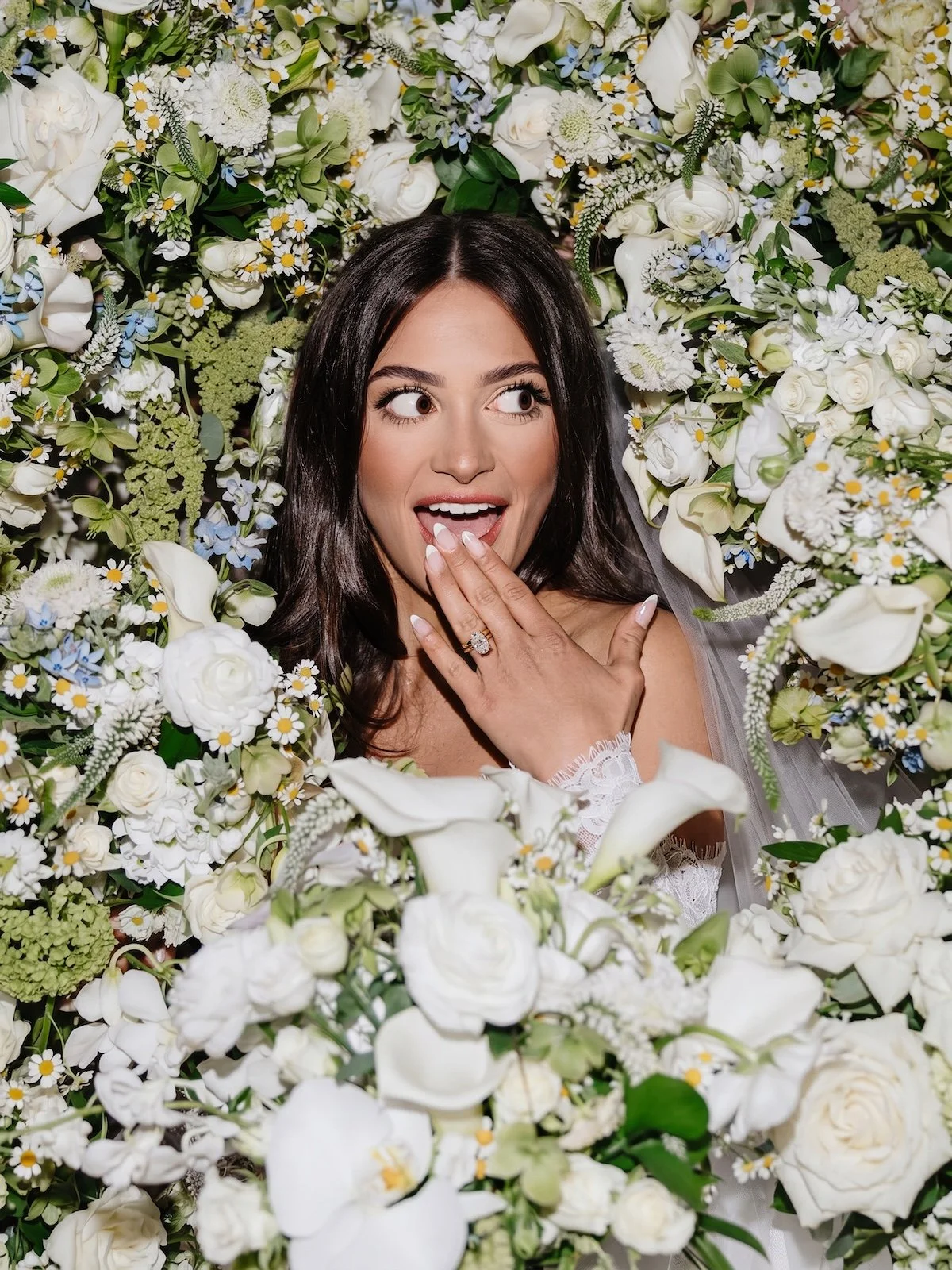
Winter weddings cost less on average, and by less than the internet suggests. The Knot's 2025 study puts the average January wedding at $29,900 and the average December wedding at $30,900, against a winter season average of $32,000 and a summer average of $34,000. The gap between the cheapest month and the summer average is around 12 %, and the gap between the winter and summer season averages is around 6 %.
That is a real difference on a large number, and it is not a discount code. The savings are concentrated in specific categories, and knowing which ones lets you plan the budget honestly.
Where the money actually comes off. Venue site fees and food and beverage minimums are the big one. A room that carries a $30,000 minimum on an October Saturday often carries far less on a non-holiday Saturday in late January, and this is the single line worth negotiating hard. Hotel room blocks are cheaper and easier to hold in the winter in both New York and Los Angeles. Friday and Sunday dates compound the effect, and The Knot's data shows Thursday as the cheapest day of the week at $31,100.
Where the money does not come off. Photography and film do not drop, because a January wedding takes the same hours, the same crew and the same weeks of post production as a June one. Our pricing does not change by season and neither does that of any studio we respect. Flowers can be more expensive, since the blooms most couples picture are out of season and imported. Heating, lighting and coat check staffing add lines that a summer wedding never sees. And New Year's Eve is priced as a holiday by every venue and every band in both cities, so it belongs in a separate mental category from the rest of winter.
Where your guests pay. Airfare and hotels around Christmas and New Year run high, and a destination wedding in that window quietly transfers a large cost to the people you invited. If a lot of your guest list is flying, the second half of January and the first half of February are the kindest weeks of the winter to choose.
How do you keep guests warm without making the day about the cold?
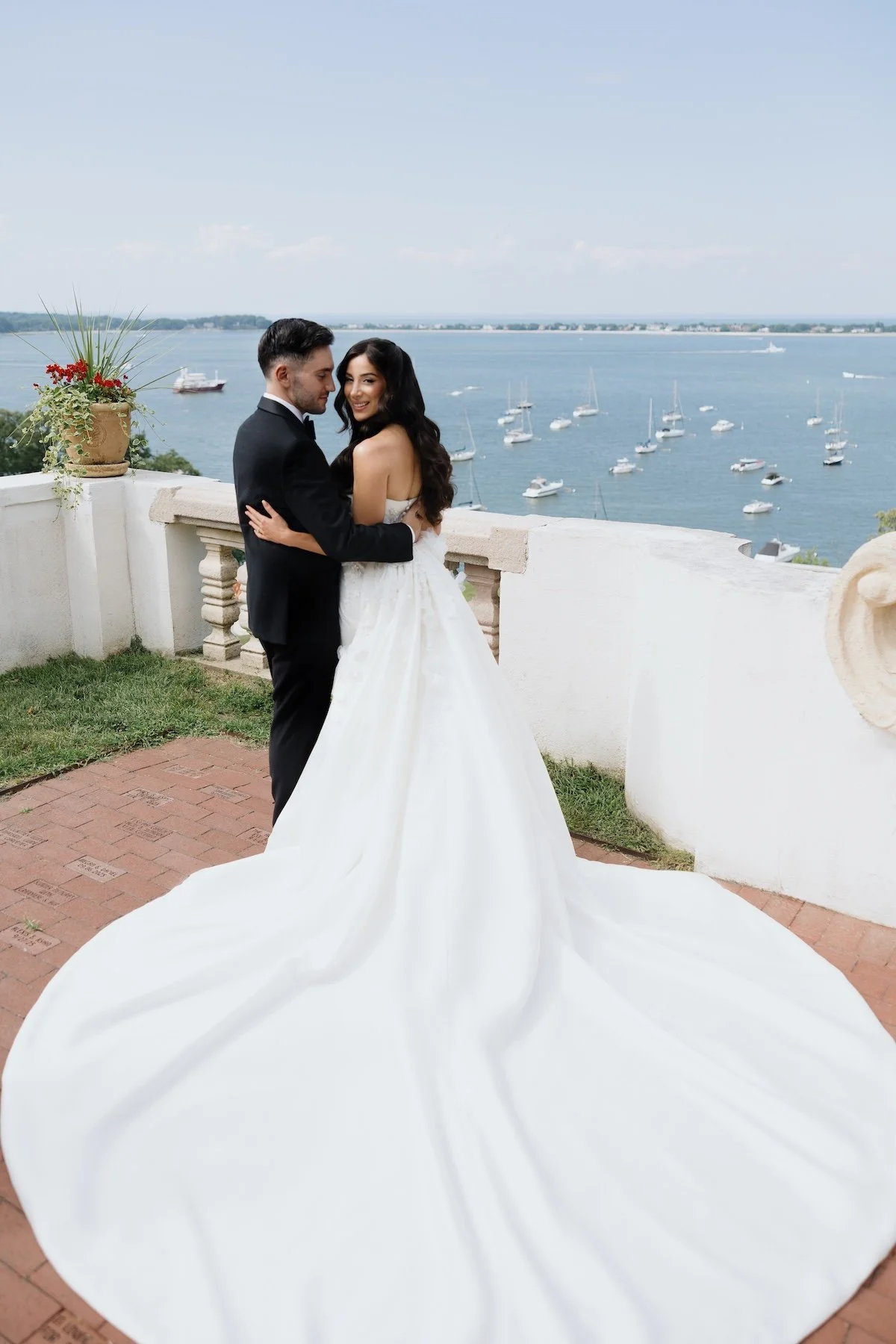
You solve it with the schedule and the floor plan first, and with blankets second. Guests are cold because of decisions made months earlier: an outdoor ceremony that runs long, an arrival area with no indoor holding space, a cocktail hour on a terrace in February. Fix those and the hand warmers become a nice touch. Leave them broken and no quantity of throws will help.
Cap outdoor ceremony time and count the wind. Below freezing, twenty minutes seated outdoors is what an average guest tolerates in wedding clothes. Wind takes that number down fast, and a waterfront ceremony in New York in January is a wind problem before it is a temperature problem.
Control the arrival. Guests show up twenty to thirty minutes early. If the only place to wait is outside, you have built a half hour of standing in the cold into the front of your day. Open an indoor space, hold people there, and seat them ten minutes before you start.
Staff the coat check properly. Ask the venue how many attendants they assign and what the rack capacity is. Two attendants for a hundred and fifty guests is a bottleneck at arrival and a worse one at the end of the night, when everybody leaves at once.
Put the warm drink at the beginning. Hot cider or cocoa handed to people as they walk in does more for the room than the same station at the end of the night, and it photographs well because guests are still in their coats and gloves.
Move people under cover. Shuttles from the hotel block matter more in winter than in summer, both because parking lots are icy and because guests in formalwear should not walk four blocks in the wind.
Then add the small comforts. Blankets on ceremony chairs, hand warmers in a basket at the door, a heater cluster where people gather to smoke or take a call. Patio heaters need clearance from fabric and a propane plan, so confirm with the venue that they are permitted indoors or under a tent before you rent them.
What changes about wedding photography and film in winter?
The season changes our schedule, our gear discipline and the way we talk to you about the timeline. It does not change what you get, and it does not change what it costs.
We are the people who show up. Both of us shoot. On a photography package, the second photographer is the other owner of the studio. On an eight or ten hour photo and film package, Andrew photographs and Roma films, and the second photographer and second videographer come from a small group of people we have worked with for years. On a six hour photo and film package there are two of us and nobody else on the call sheet. In winter that matters more than usual, because the day runs on a tighter clock and a second shooter who has never worked with us costs time we do not have.
We plan your day against the sunset, in writing. When you book a winter date we send back a timeline built on the actual sunset time for that date at your venue, with the portrait window marked. That conversation happens months out, while the ceremony time is still movable.
Cold gear needs handling. Batteries lose capacity in the cold, so we carry more of them and keep them warm. Drone coverage is included in every package, and cold air shortens flight time, so we fly early in the day and we fly with reserves. The thing that ruins winter footage is condensation: a cold lens carried into a warm ballroom fogs, inside and out, and stays fogged for fifteen minutes. We acclimate bodies and lenses in the vestibule or in sealed bags before we walk into the room, which is why you will see us waiting at the door while everyone else goes in
Audio holds up outdoors. We record from two independent sources, a feed from the venue's sound board for the ceremony and the speeches, and a directional microphone on camera. A windy outdoor winter ceremony is exactly the case where we will ask you about lavalier microphones, which we can bring on request.
Permits get filed early. Where a portrait location needs a shoot permit, we file it in advance. The city or county fee is billed to you at cost, separately from your package. Winter park hours are shorter, and a permit application in December sits in the same queue as everybody else's holiday paperwork.
Film in the cold. Super 8 and the Hasselblad 503 are included on the ten hour package and cost $900 on the six and eight hour ones. Snow on Super 8 is one of the few things that looks better on film than digital, because the grain sits in the highlights where the snow already is.
What you receive. Between 400 and 700 finished frames depending on your package, 400+ on six hours, 550+ on eight and 700+ on ten. Photographs within 30 days. The film within six months. A private online gallery for six months with unlimited high resolution downloads, full print rights and no watermarks. A 50 % non-refundable retainer reserves your date.
Who we are. Andrew is an award winning film director. Roma danced with the Bolshoi Ballet for ten years, then moved into film, and produced the shorts the awards belong to. Between us: Best Short Documentary at Venezia Shorts Italy, Best Editing at the New York Indie Shorts Awards, and Grand Jury Winner at the FFTG Awards. Commercial work for Adidas, Nutella and Mercedes. The awards are for short films, not for weddings, and we think that is the point: a winter wedding is a documentary shot in bad light on a fixed schedule, which is the same problem those films were.
If you are choosing a room in New York, our guide to
covers ten specific spaces and what each one costs. If you are working out the palette, we keep a separate piece on
And if you are weighing a winter date in California against a spring one, we wrote about
the best time of year for a Los Angeles wedding
Ready to plan a winter date?
Tell us your date and your venue and we will send back a timeline built on the real sunset time for that day, before you sign anything.
See our packages and current pricing,
or
about a winter wedding in New York or Los Angeles.
Frequently asked questions
-
Follow the dress code on the invitation and solve the warmth underneath it. For women, a floor length or midi dress in a heavier fabric with opaque tights, a wrap or a tailored coat, and closed shoes you can walk on ice in. For men, a wool suit, an overcoat and proper socks. Bring shoes you can change into if there is any outdoor portion. Black is fine at a winter wedding.
-
December is the least booked month of the year, which is exactly why it works. The Knot's data puts it at the bottom of the calendar alongside January, so venues and vendors have availability and prices sit below the annual average. The trade is daylight and the holiday calendar. A date in the first two weeks of December avoids the Christmas travel crunch and keeps most of the advantage.
-
The Knot recommends six to eight months, skewing toward eight for a holiday weekend or a destination. For a winter wedding, take the eight. Guests need to book flights before holiday fares climb, and they need to know your date before their own family plans get made. Anything under four months and you skip save the dates and send the invitation.
-
Yes, with a cap on the time and a real indoor alternative you are willing to use. Twenty minutes is the practical limit for seated guests below freezing, and wind matters more than temperature. Book a venue where the backup room is somewhere you would be happy to marry, since the decision gets made that morning and a plan B you dislike turns into a bad choice under pressure.
-
Six things: a venue with a genuine indoor backup, a timeline built backward from sunset, an indoor holding area for guest arrival, adequate coat check, transport between the hotel block and the venue, and warm drinks at the door. Everything else on the standard winter checklist, the blankets, the hot cocoa bar, the faux fur wraps, is decoration on top of those six.
-
Most do not, and be careful with anyone who does. A January wedding takes the same coverage hours, the same crew and the same editing weeks as a June one, so a genuine seasonal discount usually means fewer hours, a smaller team or a slower delivery. Our pricing is the same in every month. The savings on a winter wedding come from the venue and the guest count, not from the people documenting it.
-
Work backward from sunset at your venue on your date. In New York in December, sunset is around 4:30 pm, so a ceremony between 4:00 and 5:00 pm lets you take portraits in the last real light beforehand and hand the evening to the reception. In Los Angeles you get about fifteen more minutes. If your venue fixes an earlier ceremony time, plan portraits for after it and accept that the best light of the day sits at the end of your session.